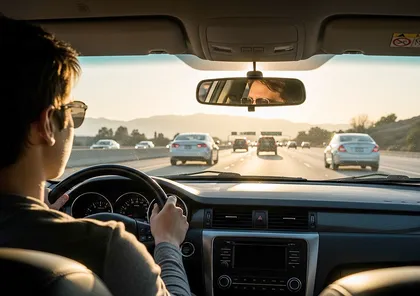
Some driving situations give you a clear view of everything ahead. Others do not. A delivery van may block part of an intersection, parked SUVs can hide pedestrians, or a row of vehicles can make it difficult to see traffic approaching from the side.
For a learner, the uncertainty can be uncomfortable. There is a temptation either to wait forever or move forward too quickly just to find out what is there. Neither approach is particularly useful. The better habit is learning how to deal patiently with what you cannot yet see.
Treat a Blocked View as Information
Not being able to see something is important information by itself. If a large vehicle blocks your view near an intersection, you should not assume the hidden area is empty.
This sounds obvious when discussed away from the road, but it can be forgotten while driving. Learners sometimes focus on what is visible and give little thought to what might be hidden. Recognizing that uncertainty is the first step toward handling it sensibly.
Slow Down Before You Need an Answer
Imagine approaching a street lined with parked vehicles. You cannot clearly see whether somebody is about to step between them.
Waiting until a person appears before changing speed leaves very little time. Reducing speed earlier, when appropriate, gives you longer to observe the area. It also means that if something does appear, your response does not have to be as sudden.
Learn to Move From Clue to Clue
Sometimes you cannot see the entire situation, but smaller details provide useful clues. A vehicle’s wheels may be visible beyond an obstruction. You might notice movement through another car’s windows or see a pedestrian approaching a gap between parked vehicles.
During driving lessons sugar land, learners can work on observation as part of practical driving experience. With time, they can become better at noticing these details instead of waiting for a hazard to appear directly in front of them.
Do Not Let the Driver Behind Make the Decision
Blocked views become more stressful when another vehicle is waiting behind you. The learner may feel pressure to move because they believe they are holding up traffic.
The vehicle behind does not have your exact view. If you need another moment to understand the situation, impatience from somebody else does not suddenly improve visibility. Make the decision using what you can actually see.
Be Careful Around Larger Vehicles
Trucks, vans, and large SUVs can hide much more of the road than smaller cars. This matters in parking lots as well as at intersections.
A pedestrian can disappear completely behind a large parked vehicle. Another car may also be approaching from the other side without being visible immediately. Rather than treating the obstruction as an annoyance, expect that something could emerge from behind it.
Study Helps Explain What You Meet Outside
Practical driving teaches learners how quickly a simple-looking situation can change. Formal driver education provides another part of the picture by helping learners understand road rules, signs, and responsibilities before they have to apply them in traffic.
An online permit course texas allows that learning to take place away from the pressure of controlling a vehicle. Once practical driving begins, the learner can start connecting those ideas with situations that are less tidy than examples on a screen.
Do Not Guess Just to Keep Moving
There will be times when the view is simply not good enough to make the next move confidently. Guessing is not a driving technique.
Take the time required to gather more information while remaining in an appropriate position. Conditions may change within a few seconds. A vehicle could move, traffic may clear, or the view may improve enough to make the decision straightforward.
Conclusion
Blocked visibility turns an ordinary road into a small exercise in patience. The important question is not always, “Can I go?” Sometimes it is, “Do I actually have enough information yet?”
Learning to respect that difference can prevent rushed decisions. As practical experience grows, learners become better at spotting clues, adjusting earlier, and accepting that waiting a few extra seconds is sometimes the sensible choice. Driver education and behind-the-wheel options through myfirstdrive.net can support that development, but careful observation is a habit every learner has to build, one drive at a time.